

Flexibility often gets treated as the quieter part of fitness. Strength training gets attention because we can measure the weight. Cardio gives us heart rate, pace, and distance. Flexibility can feel less urgent until everyday movements start getting harder.
A long-term Brazilian study suggests it deserves more attention.
Researchers followed 3,139 adults between ages 46 and 65 for roughly 13 years. About 66% of participants were men. During the follow-up period, roughly 300 people died, close to 10% of everyone studied.
People who survived generally had better flexibility scores.
That result does not mean stretching automatically extends your life. Researchers found an association between flexibility and survival, not proof that improving your range of motion will make you live longer.
If your range of motion keeps shrinking, ordinary tasks can become harder.
Walking comfortably, reaching overhead, bending to pick something up, exercising, and getting onto the floor all require usable movement at several joints.
How Researchers Measured Flexibility
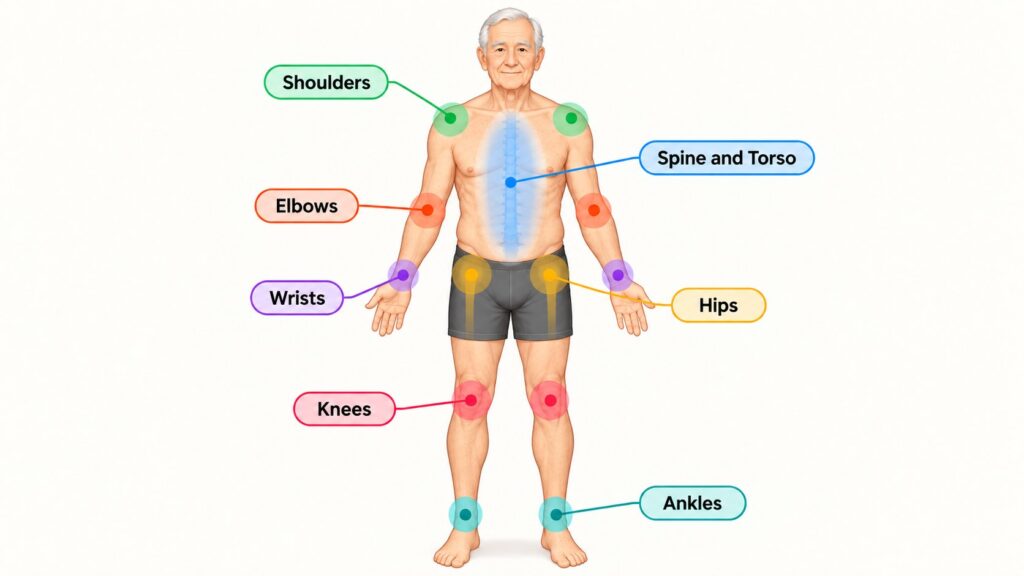
Researchers used a method called the Flexitest, developed by lead author Dr. Claudio Gil S. Araújo more than 40 years ago.
Participants completed 20 movements that assessed range of motion in seven areas:
- Ankles
- Knees
- Hips
- Spine and Torso
- Shoulders
- Elbows
- Wrists
Using several joints matters because flexibility is not one quality that your entire body either has or does not have.
Someone can have excellent hip mobility and restricted shoulders. Another person may easily reach toward the floor but have limited ankle movement that changes how they walk, squat, or climb stairs.
A toe-touch test cannot show all of that.
Toe touching mainly gives information about areas such as the hamstrings, glutes, lower back, and the way those regions coordinate during the movement. It tells you very little about your wrists, elbows, shoulders, or ankles.
Touching your toes does not mean your body moves well everywhere.
Your hips may move freely while your ankles or shoulders are becoming increasingly restricted.
What the Study Found
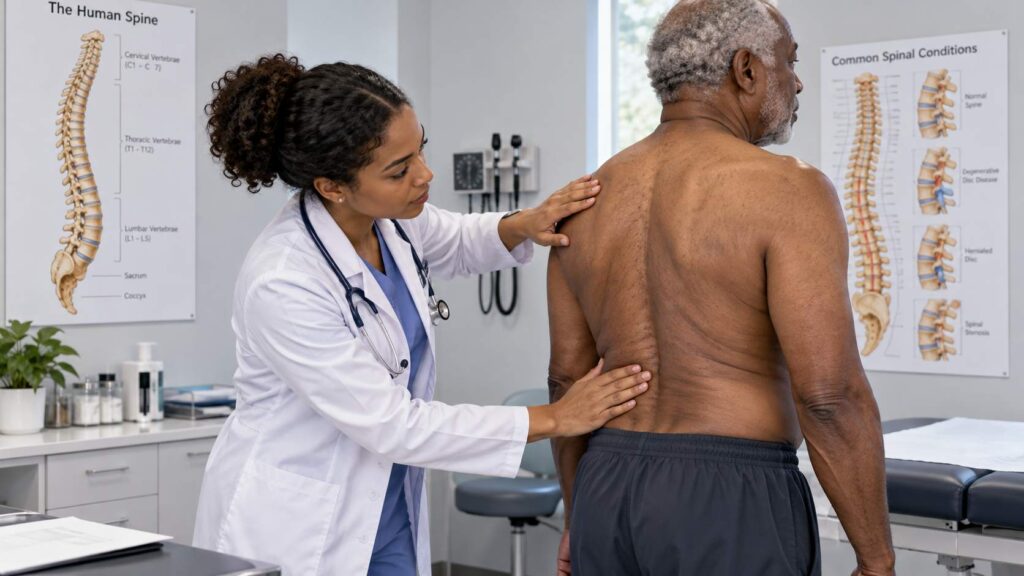
People who survived the follow-up period had flexibility scores nearly 10% higher than participants who died.
Researchers also adjusted their analysis for factors including age, body mass index, and health status. Lower flexibility was still associated with considerably greater mortality risk.
Among men, lower flexibility was associated with about 1.87 times the mortality risk.
Among women, the figure was about 4.78 times the risk.
Numbers like 4.78 can sound dramatic, but they need careful interpretation.
A flexibility score cannot tell an individual how long they will live. Population-level associations describe patterns across groups. They do not function like personal expiration-date calculators.
Many variables may also sit behind a low flexibility score.
Someone who moves less because of illness, pain, injury, or general physical decline may become less flexible at the same time that other health risks increase.
Why Flexibility Might Be Linked With Longevity

Range of motion generally decreases as people get older. Research cited alongside the Rio study suggests hip and shoulder range may decline by roughly 6 degrees per decade after the 50s.
Another study found that shoulder abduction declined by about 5 degrees per decade in men and 6 degrees in women.
Hip flexion fell by about 6 degrees per decade in men and 7 degrees in women. A few degrees at one joint may not look important, but losses across several joints can gradually change how comfortably you reach, walk, bend, and exercise.
Better flexibility may also help reduce pain and support mobility, making continued activity easier. Activity itself has many established health benefits, so flexibility could partly matter because it helps people keep doing other valuable forms of movement.
Falls offer another possible connection.
Enough range at your ankles, hips, shoulders, and spine can give you more options when you lose balance.
Mobility can help you reposition your feet, absorb force, reach for support, or organize your body as you recover.
What It Means for Your Own Training
Extreme flexibility is not required.
Useful flexibility is a better target.
Aim to maintain enough motion to walk normally, reach overhead, hinge at your hips, squat to a comfortable depth, rotate your torso, and move onto and off the floor.
Those abilities tell me much more about practical mobility than how impressive one stretch looks.
Flexibility is also trainable at any age, and improvement does not necessarily require long stretching sessions.
One meta-analysis reported no additional flexibility gains once stretching reached roughly four minutes per workout or about 10 minutes per week for an individual muscle.
Consistency and appropriate technique matter more than sitting in one stretch for an excessive amount of time.
Stretching is not your only option either. Strength training performed through a full range of motion can help improve or preserve mobility. Yoga and tai chi can also give joints regular opportunities to move through controlled ranges.
Choice depends partly on what is restricted and why.
Muscle stiffness is one possibility. Joint structure, previous injuries, pain, nervous-system sensitivity, training habits, and simple lack of movement can all affect range.
We often see people try to fix every restriction by pushing harder into a stretch. That approach can miss the actual problem.
Training becomes much more useful once you can answer it.
The Bottom Line
Fitness in later life involves more than one quality.
Current CDC guidance gives some scale to those priorities. Adults 65 and older are advised to get at least 150 minutes of moderate aerobic activity each week, train their muscles on at least two days, and include balance work.
Flexibility should support that work rather than replace it. Enough range can make strength exercises, walking, balance practice, and ordinary daily movement easier to perform well.
Results of the Rio study suggest whole-body flexibility deserves a place in that conversation.
Lower flexibility was associated with poorer survival across roughly 13 years, even after researchers accounted for several health-related factors.
Researchers still need to determine if deliberately improving flexibility through stretching, yoga, tai chi, strength training, or other methods can actually increase lifespan.
For now, a more practical goal makes sense.