

Static stretching has picked up a bad reputation in warm-ups. Research has linked it with temporary reductions in strength, power, speed, and balance, which sounds like a good reason to keep stretching away prior to a hard workout.
Look closer at how some of those studies were conducted, though, and an important detail appears.
Across studies, average performance reductions were around 3 to 5%. Many experiments also asked people to hold stretches much longer than most athletes would during a normal warm-up.
Participants sometimes stretched an individual muscle for more than a minute. A few protocols involved 20 to 30 minutes of stretching.
That is not the same warm-up most people are doing before a run, lifting session, or fitness class.
Keep static stretching under about 60 seconds per muscle, place it inside a complete warm-up, and its effect on performance looks very different.
A better question, then, is not simply, “Should I stretch before exercise?” Ask how long you are holding the stretch and what movement comes next.
Why Long Static Holds Can Be a Problem
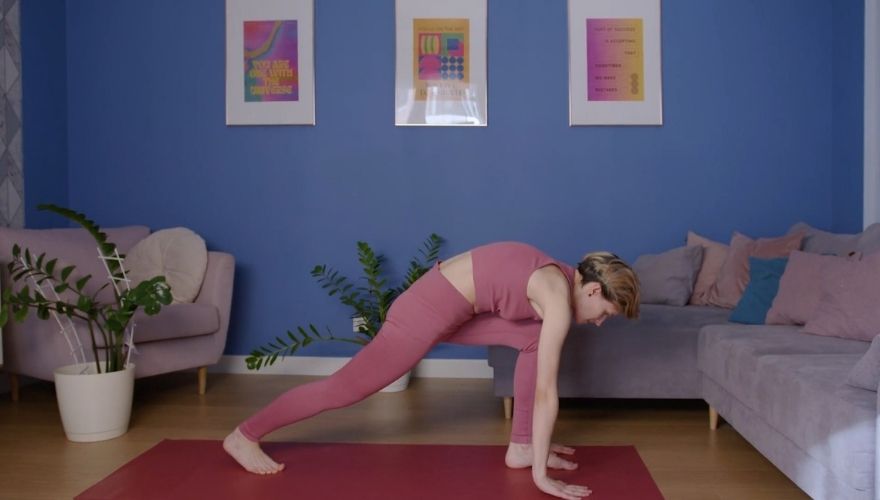
Long passive stretches are most questionable when they happen immediately before an activity requiring high levels of force, speed, or power.
Holding a muscle at the end of its available range can temporarily reduce tendon stiffness. Some stiffness is useful during explosive movement because tendons help transfer force as you sprint, jump, or change direction quickly. Reducing that stiffness temporarily, force production may change as well.
Effects can last minutes to hours, depending on the stretching dose and what happens afterward.
Holding a hamstring stretch for several minutes and immediately lining up for a maximal sprint is one situation. Holding it for 20 or 30 seconds, getting up, performing leg swings and running drills, then gradually increasing speed is another.
We can see people treat both situations as “stretching before exercise,” but they place very different demands on the body.
Longer is not automatically better, especially when your next task depends on producing force quickly.
Under a Minute Is a Different Story
Research looking at more realistic warm-ups gives short static stretching a much better result.
Static stretching lasting less than 60 seconds per muscle produced no significant performance reduction when placed between lower-intensity exercise and higher-intensity, sport-specific preparation.
Average change in sprint speed under those conditions was only −0.15%. That number matters because it puts the usual warning about pre-workout stretching into perspective. A brief stretch inside a proper warm-up is not behaving like several minutes of passive stretching followed immediately by a maximal effort.
Professional athletes also tend to use shorter holds than those seen in many older experiments. Average stretching times of roughly 12 to 17 seconds per muscle have been reported in practice.
You do not need to treat 60 seconds as a hard biological deadline, either. Your muscle does not suddenly change behavior when a stopwatch moves past 59 seconds. Think of one minute as a useful practical boundary when performance matters.
For most warm-ups, even less may be enough.
Static Stretching Should Be Part of the Warm-Up, Not the Whole Warm-Up

A short static stretch can have a place before exercise.
Sitting on the floor stretching for ten minutes and then walking straight to a heavy barbell is another matter.
Dynamic movement should do much of the preparation before demanding exercise because it takes your joints and muscles through movements related to what you are about to do.
One controlled study makes that point nicely. Twenty team-sport athletes completed warm-ups using either:
- 5-second static stretches
- 30-second static stretches
- Dynamic stretching
Sprinting, jumping, and change-of-direction performance did not differ significantly between conditions. Short stretching was not doing measurable damage once the rest of the warm-up was in place.
Say your calves feel restricted before squatting.
A brief calf stretch may help you access ankle motion more comfortably. Follow it with ankle movement and several progressively deeper squats.
Hamstrings are another common example. A short hamstring stretch may feel useful before running, but we would follow it with leg swings, lunges, marching drills, or easy running rather than treating the stretch as the completed warm-up.
A simple pattern works well:
- Brief calf stretch, followed by ankle movement and squats.
- Brief hamstring stretch, followed by leg swings, lunges, or running drills.
If you stretch and then stand around, you have not finished warming up. Use the new range during movement so your body practices controlling it before training intensity increases.
When a Short Static Stretch Makes Sense
Pre-workout stretching is most useful when it has a specific job.
Maybe ankle restriction makes your squat uncomfortable. Perhaps your shoulders need a little more range before an overhead movement. A brief stretch may also help if a familiar area feels stiff at the start of training and you know a short hold usually improves how you move.
Activities requiring larger ranges of motion can also justify some carefully chosen static stretching before exercise.
Aim for enough range to perform the activity well. Warm-up stretching is not the time to spend several minutes trying to make a major flexibility change.
That distinction is important. Flexibility training asks, “How can I gradually improve available range over time?”
A warm-up asks, “What range do I need today, and can I control it during the activity I am about to do?”
Those goals overlap, but they are not identical.
When to Be More Cautious

Extra caution makes sense before maximal sprinting, jumping, heavy explosive lifting, or similar high-power work.
Prolonged passive stretching just before those activities may temporarily reduce force production. Give dynamic and activity-specific preparation more attention instead.
But what actually happens to your muscles when you stretch them? Learn more in our article about how stretching really affects your muscles.
Also pay attention to why you feel tight in the first place.
Not every feeling of tightness means a muscle needs a longer stretch. Weakness can create a similar sensation. Limited joint mobility, poor movement control, training fatigue, or several factors at once may also contribute.
Lack of muscular stability can feel like tightness too.
We often see people respond to every restriction by stretching harder or holding longer. Sometimes that works. Sometimes they are repeatedly stretching tissue that was never the main problem.
If you have stretched the same area for months and it still feels restricted, another two-minute hold may not change much. Look at joint motion, strength, technique, and control as well.
A Simple Pre-Workout Approach
You do not need an elaborate stretching routine before every workout. Give each part of your warm-up a reason for being there.
A practical sequence looks like this:
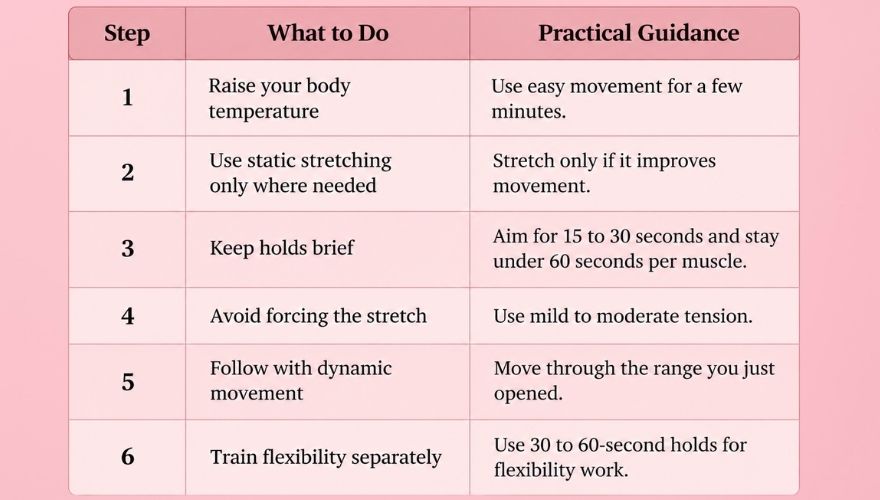
Adjust those steps to the activity in front of you. Someone preparing for yoga may need a different warm-up than someone preparing for a 100-meter sprint, even if both include a little static stretching.
More stretching time does not keep buying the same amount of progress.
An analysis covering 189 studies and 6,654 adults found flexibility gains reached their maximum at roughly 4 minutes of cumulative static stretching per session and 10 minutes per week.
Past those amounts, researchers found no additional flexibility benefit. Consistency matters more than turning every stretch into a marathon.
Closing Thoughts
Static stretching before exercise is not automatically a problem. Longer passive holds performed immediately before explosive work deserve more caution.
Shorter stretching tells a different story.
Keep a static stretch under about a minute per muscle, place it inside a full warm-up, and available research shows no meaningful performance loss under those conditions. Dynamic movement should still carry most of the workload when you are preparing to sprint, jump, lift, or train hard.
Use a brief stretch when it helps you access the motion you need. Follow it with movement that asks you to control that range.
Your warm-up should prepare you to perform, not become a separate flexibility session.