
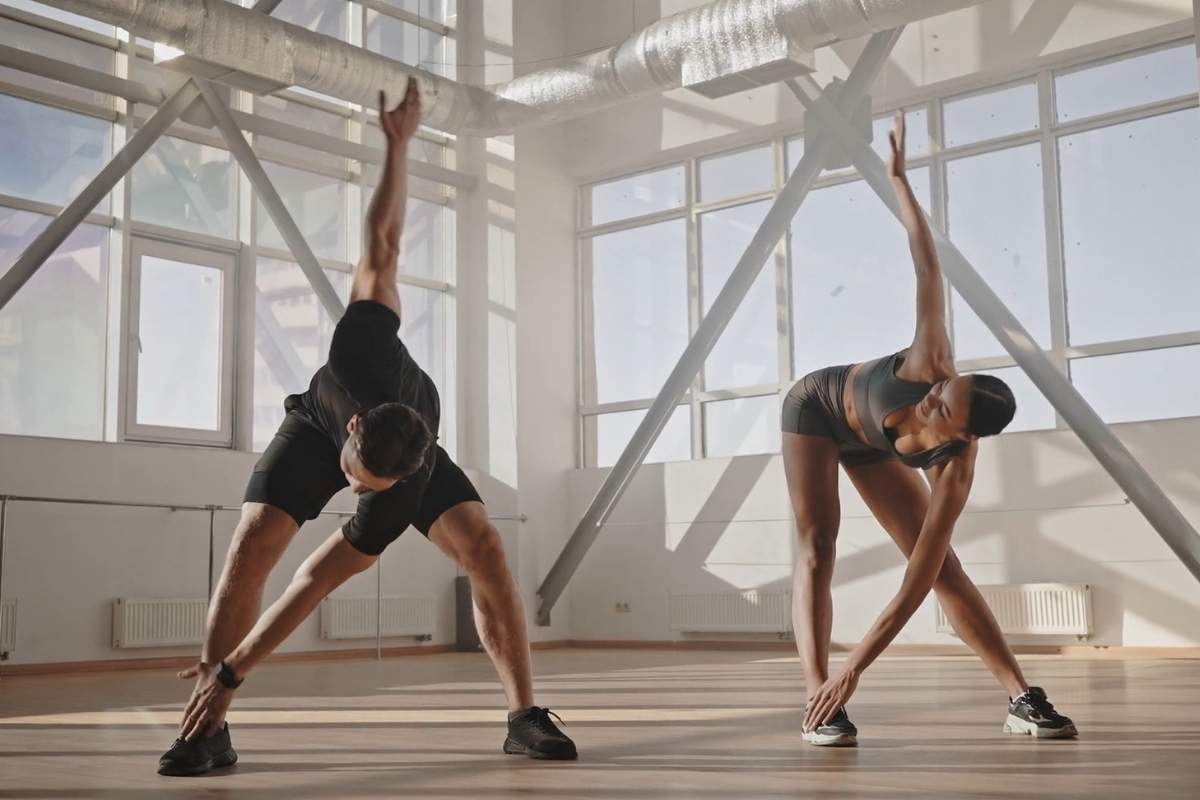
A tight hamstring feels like a short hamstring. Reach toward your toes, feel that familiar pulling sensation, and it is easy to picture muscle fibers that simply need to be stretched longer.
Stretching can improve range of motion and reduce stiffness, but flexibility gains are strongly influenced by how much tension and range your nervous system is willing to tolerate.
Muscle tissue matters, but your brain and nervous system are also involved in deciding where a movement starts to feel uncomfortable, uncertain, or difficult to control.
You can see this during a single stretching session. Reach toward your toes once, rest, then repeat the movement a few times. Many people can reach noticeably farther within several minutes.
Your hamstrings did not physically remodel in ten minutes.
Something changed in how you experienced and tolerated that position.
What Actually Happens When You Stretch
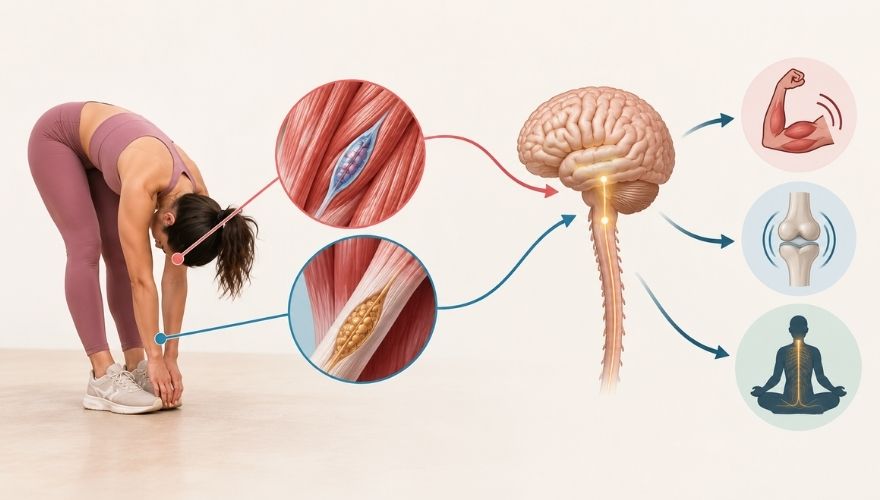
Stretching creates mechanical tension, but it also gives your nervous system a steady stream of sensory information.
Receptors in muscles and joints report changes in position, tension, and movement. Muscle spindles are sensitive to changes in muscle length, while Golgi tendon organs respond to tension. Your nervous system uses that information while regulating muscle activity and assessing how manageable a position feels.
For a closer look at how stretching affects your muscles, watch the video below.
Repeatedly entering a position can make that range more familiar. As your nervous system gets more experience with the movement, you may experience less unnecessary protective tension and become more comfortable near the end of your range.
After several controlled repetitions, the position feels less threatening, and movement becomes easier even though no meaningful structural change could have happened that quickly. Stretching exposes tissues to tension while also giving your nervous system repeated information about a position.
Stretch Tolerance May Matter More Than Muscle Length
Stretch tolerance describes how much tension or discomfort you can accept before deciding you have reached your limit.
An analysis of 19 studies found average hamstring improvements of about 8 to 12 degrees, depending on the flexibility test used.
What those extra degrees do not tell us by themselves is why the range increased. A larger number on a flexibility test is an outcome, not an explanation of the mechanism. For instance, picture a seated hamstring stretch. You lean forward until the sensation becomes strong enough that you naturally stop.
After several weeks of regular stretching, you may reach farther before experiencing that same level of discomfort. Muscle length alone cannot explain every part of that change.
Your nervous system may simply be less protective around a position it now recognizes. Such changes also help explain why flexibility can improve relatively quickly. Significant structural changes in muscle tissue take time. Changes in sensation and tolerance can happen much sooner.
A 2025 analysis covering 65 studies and 1,542 adults gives that idea some weight. Long-term static stretching produced a moderate increase in how much passive resistance participants could tolerate, and greater stretch tolerance was significantly linked with greater range of motion.
Researchers also found no significant overall change in muscle fascicle length. In other words, people gained usable range even when measurable muscle length did not clearly change.
Does Stretching Ever Make Muscles Longer?
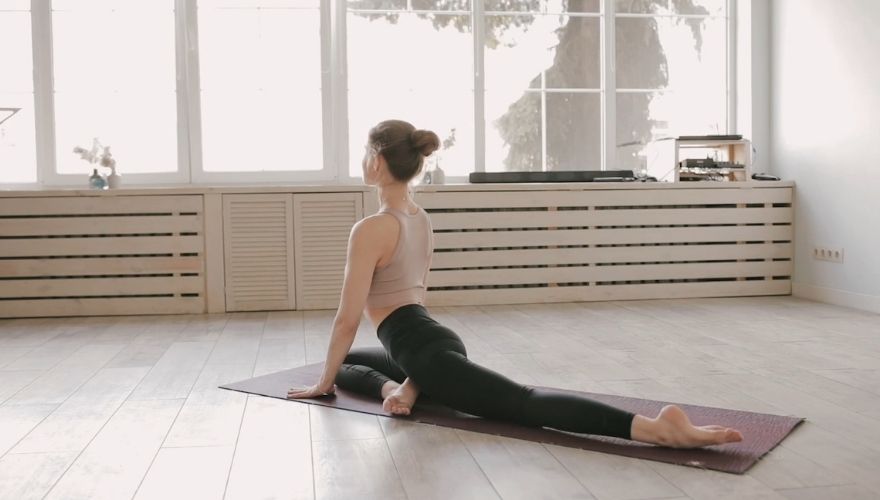
Muscle tissue can adapt.
Long-term training can produce structural changes depending on the exercise, intensity, frequency, and total training volume involved. Flexibility work is no exception.
Problems start when every flexibility improvement gets explained with the same simple story: a muscle was short, stretching pulled it longer, and now you are flexible.
Inactivity does not automatically mean muscles physically shrink into a permanently shortened state that must be pulled back to normal.
Greater range of motion can develop through several mechanisms at once. Stretch tolerance may increase. Muscle-tendon stiffness may decrease. Coordination can improve. Protective tension may become less pronounced. Structural adaptations can also contribute when training provides enough stimulus over time.
A more useful model looks like this:
An older model looks like this:
Why Forcing a Deeper Stretch Is Not Better
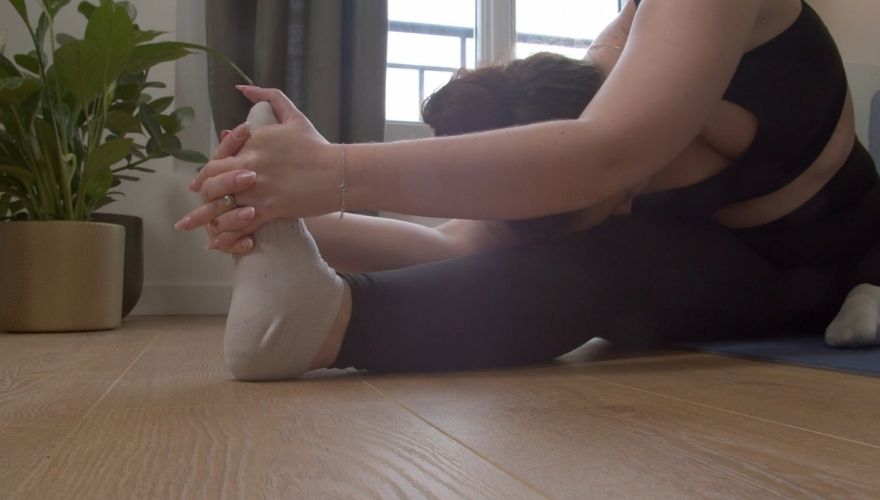
More discomfort does not mean you are getting more benefit.
Aim for mild, manageable discomfort during static stretching, not significant pain. Pushing aggressively can place unnecessary stress on muscles, ligaments, and joints without giving you an extra flexibility advantage.
Breath-holding is another useful clue.
If you enter a stretch and immediately hold your breath, brace hard through your abdomen, tense your shoulders, or feel yourself wanting to recoil, reduce the range and reassess your position.
Those reactions do not prove that something is neurologically wrong. They simply tell you that the current position may be too demanding to practice well.
Take a standing forward fold. Someone may proudly reach several inches lower after a few weeks of practice, but that improvement tells us very little unless we look at how they got there. If your back rounds as you reach lower, you are not necessarily improving the hamstring stretch. You may simply be finding movement somewhere else.
The same problem appears in hip stretches. A person trying to improve hip rotation may twist the pelvis or collapse through the spine to create the appearance of greater range.
Movement has to come out of the area you are actually trying to train.
Otherwise, you may be getting better at compensating rather than improving the movement you intended to improve.
How to Stretch More Effectively
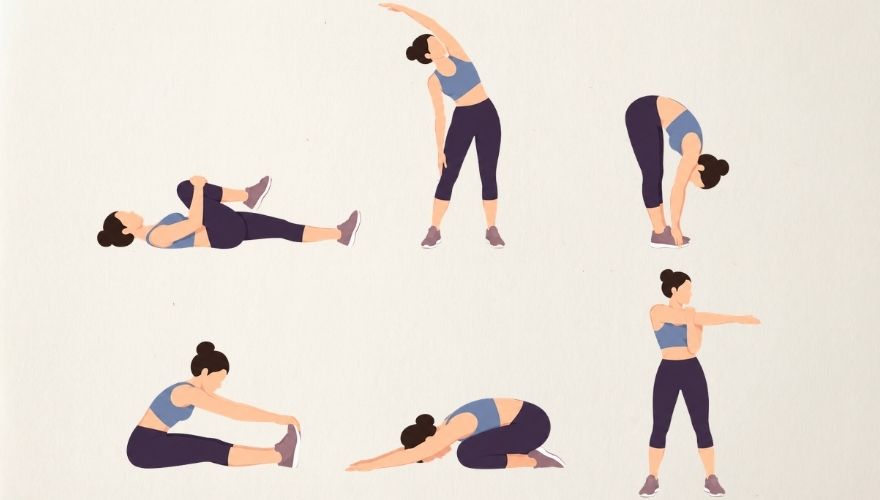
Start with a short warm-up when you are preparing for a dedicated flexibility session. Around 5 to 10 minutes of light aerobic activity can raise tissue temperature and prepare you to move.
Dynamic movement usually makes more sense before sport or demanding exercise.
One large review found a small average performance improvement of 1.3% after dynamic stretching, while static stretching was associated with a 3.7% reduction when performance was tested shortly afterward. Longer static work mattered more.
At least 60 seconds per muscle group was linked with a 4.6% reduction, compared with 1.1% when total static stretching stayed under 60 seconds. A long passive hold is therefore not my first choice immediately before sprinting, jumping, or heavy lifting.
For most adults, static stretches lasting roughly 10 to 30 seconds and repeated two to four times can be enough to produce useful flexibility work.
For a practical look at how long to hold a stretch, Upright Health explains how different factors can influence the ideal hold time and clears up some common misconceptions about stretching duration.
That does not mean everyone needs exactly four minutes on every muscle. It tells us something more practical: you do not need to spend half your workout hanging painfully at the edge of a stretch.
If you cannot breathe normally, lose your intended position, or start compensating somewhere else, reduce the range. A slightly easier stretch performed well is usually more useful than a dramatic position held badly.
Pair stretching with active mobility and strength whenever possible.
Someone improving ankle dorsiflexion, for example, might use a calf stretch and then practice controlled knee-over-toe movement.
Someone working on hip flexibility might follow passive stretching with slow active leg lifts or strength exercises that use the newly available range.
Progress should not be judged only by how far your fingers travel.
Ask better questions:
- Can you enter the position with less resistance?
- Can you maintain it without bracing unnecessarily?
- Can you control the range without using your hands?
- Can you use that range during the movements that matter to you?
Flexibility Is More Than Muscle Length
Improved flexibility can involve:
- Greater stretch tolerance
- Reduced stiffness
- Less unnecessary protective tension
- Better proprioceptive information
- Improved movement control
- Structural adaptation when training provides enough stimulus
Your nervous system is an important part of that process, but it is not a magical switch controlling every restriction.
Sometimes stiffness is primarily mechanical. Sometimes strength is missing. Sometimes technique changes the apparent range. Sometimes discomfort or injury affects movement. Often, several factors are involved at once.
Good flexibility training accounts for that complexity without making it complicated. Use manageable tension. Breathe normally. Keep the movement honest. Strengthen the range you gain. Give your nervous system repeated opportunities to experience positions that feel controlled rather than chaotic.
Instead of asking, “How much farther can I pull this muscle?” ask something more useful:
“Can I enter this range with manageable tension, control the position, and gradually make that movement easier to use?”