
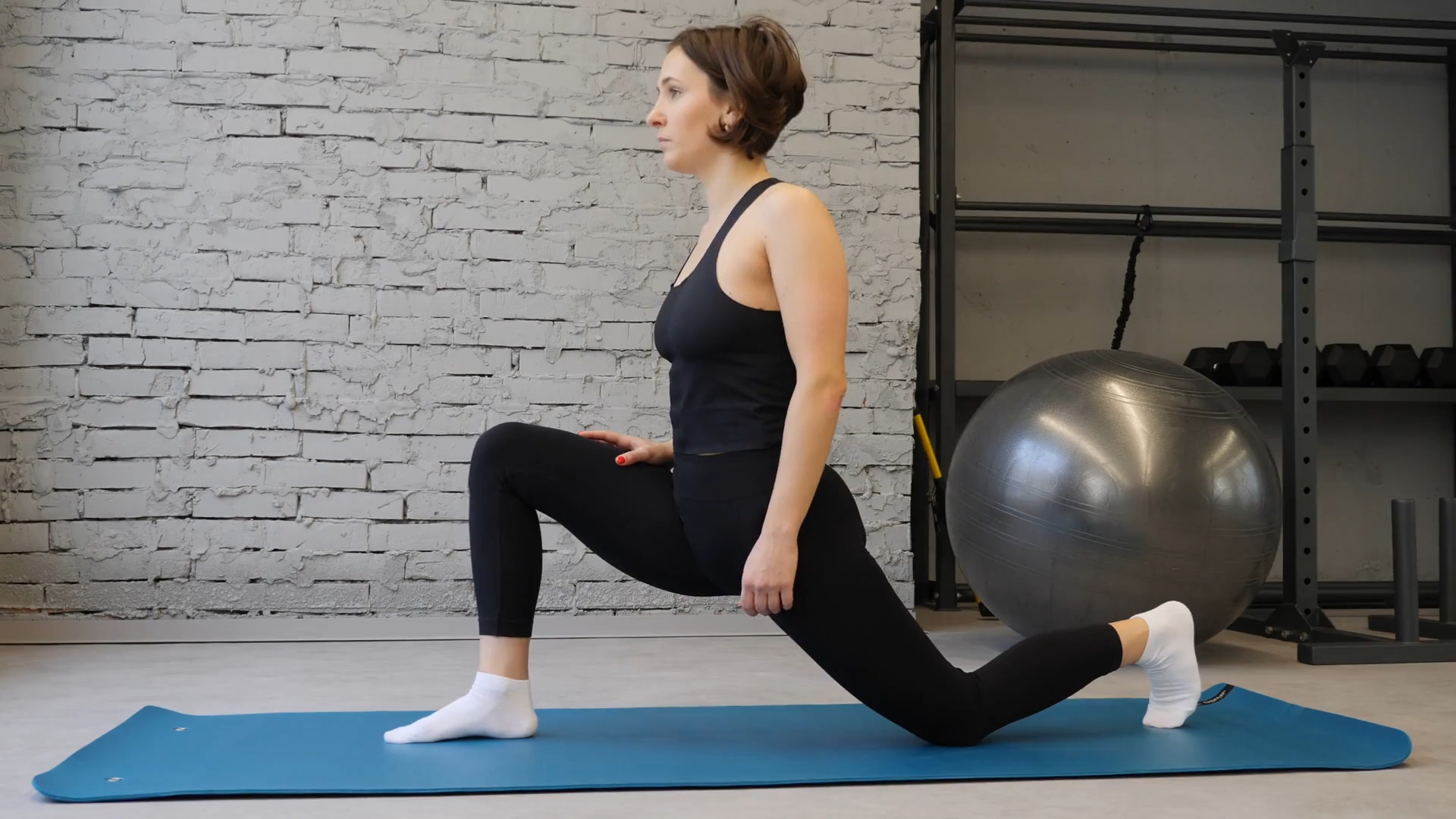
You get up after several hours at your desk, take a few steps, and notice that the front of your hips feels stiff. Standing upright takes a moment, and stretching your legs backward seems like the obvious solution.
Prolonged sitting can contribute to hip stiffness, but not every stretch addresses the muscles responsible.
One distinction matters when assessing stretching technique: how far someone moves tells us very little unless we also look at which joints are moving.
Effective hip flexor stretches focus on controlled hip extension rather than exaggerated positions.
Four exercises are particularly useful for desk workers:
| Stretch | How to Perform It | Where to Feel It |
|---|---|---|
| Half-Kneeling | Kneel, tuck your pelvis, squeeze your rear glute, and shift forward. | Front of hip and upper thigh. |
| Standing | Step back, tuck your pelvis, and shift forward gently. | Front of rear hip. |
| Supine | Lie near a bed’s edge, hug one knee, and lower the opposite leg. | Front of lowered hip. |
| Side-Lying | Lie on your side, hold your upper ankle, and move your thigh backward. | Front of thigh. |
1. Half-Kneeling Hip Flexor Stretch – Best Overall
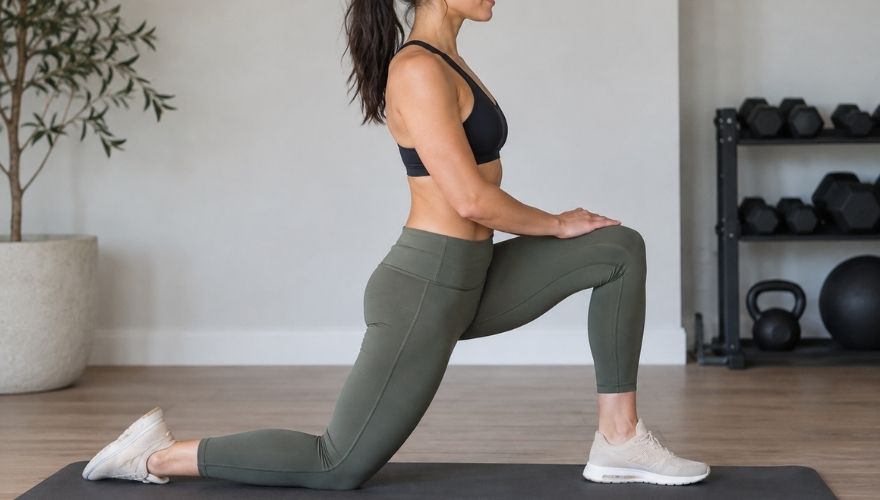
A kneeling hip flexor stretch is one of the most practical options because it allows you to control your pelvis while moving the rear hip into extension. How to perform it:
- Kneel on a padded surface with your right foot forward and left knee on the floor.
- Position your right knee approximately above your ankle.
- Gently tuck your pelvis under, as though bringing your belt buckle slightly toward your ribs.
- Squeeze your left glute and shift your hips forward a small amount.
- Hold for 20-30 seconds, then switch sides.
You should feel a gentle pulling sensation at the front of your left hip, possibly extending into the upper thigh.
Common mistake: Pushing the hips forward while arching the lower back. A small posterior pelvic tilt helps prevent the lumbar spine from providing movement that should come through hip extension.
Once you can maintain that position comfortably, you can experiment with other variations. Hip flexor stretches for every level, from kneeling lunge to couch stretch, offer different levels of difficulty, although more challenging positions aren’t necessarily more effective.
Choose a variation that allows you to control your pelvis without compensating through your lower back.
A 2024 clinical trial involving 26 adults found that stretching with a posterior pelvic tilt significantly reduced reactive hip flexor force, while conventional hip extension stretching produced no significant change.
Moving your hips further forward isn’t necessarily the most effective approach. A small pelvic adjustment may help you target the intended muscles more precisely.
2. Standing Hip Flexor Stretch – Best for Office Breaks
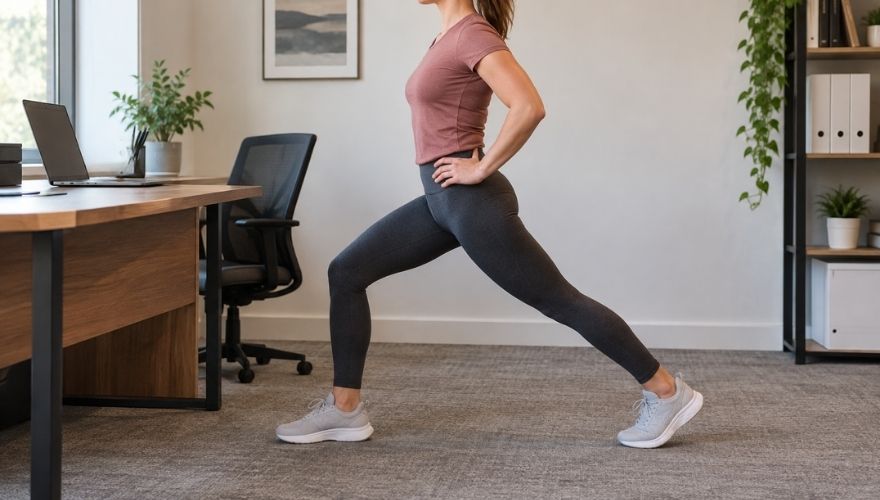
A standing hip flexor stretch for sitting is convenient when you need relief during the workday without getting onto the floor.
How to perform it:
- Step your left foot backward into a comfortable split stance.
- Keep both feet pointing forward and your torso upright.
- Gently bend your front knee while keeping your rear leg relatively straight.
- Tuck your pelvis slightly and engage your left glute.
- Shift your weight forward until you feel tension at the front of the left hip.
- Hold for 20-30 seconds before changing sides.
Common mistake: Leaning your chest forward and increasing the arch in your lower back. Keep your ribs positioned over your pelvis. Allow the rear heel to rise if necessary, and use a desk or wall for balance.
Shorter steps may produce a better-controlled stretch than an exaggerated lunge.
For office workers, this variation has another advantage. You can perform it during brief standing breaks without interrupting your routine for an entire exercise session.
3. Supine Hip Flexor Stretch – Best for Gentle, Supported Stretching
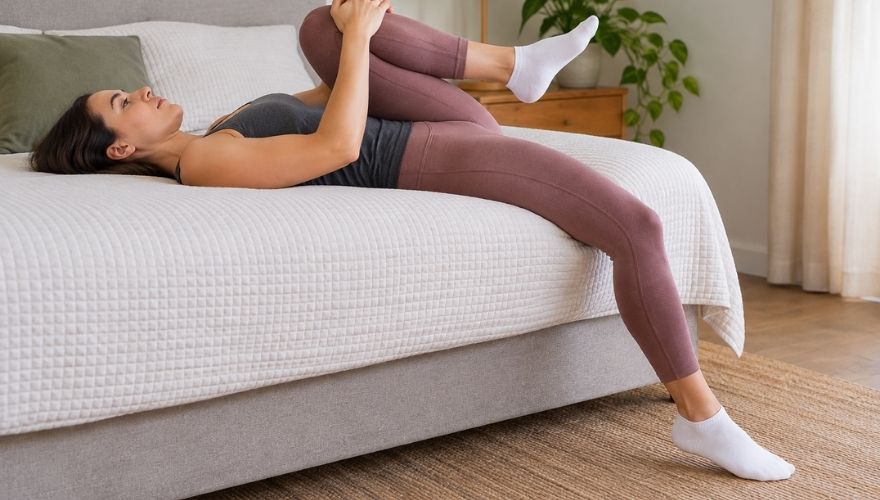
A supine stretch supports your back and removes much of the balance required during standing or kneeling exercises. It’s particularly helpful when maintaining an upright position makes pelvic control difficult.
How to perform it:
- Lie on your back near the edge of a stable bed or firm treatment surface.
- Position one thigh near the edge, leaving enough support beneath your pelvis.
- Bring your opposite knee gently toward your chest.
- Allow the leg nearest the edge to lower gradually, keeping your pelvis steady.
- Hold for 20-30 seconds, then repeat on the opposite side.
You should feel mild tension at the front of the lowered hip.
Common mistake: Allowing your lower back to arch excessively as the leg drops. Holding the opposite knee toward your chest helps limit excessive pelvic movement. If the lowered leg cannot descend very far without discomfort or spinal arching, stop at your available range.
Choose a stable, sufficiently high surface that allows the leg to lower without forcing the knee or foot against the floor. Avoid soft mattresses that make your pelvis sink unevenly.
4. Side-Lying Hip Flexor and Quad Stretch – Best for Front-of-Thigh Tightness
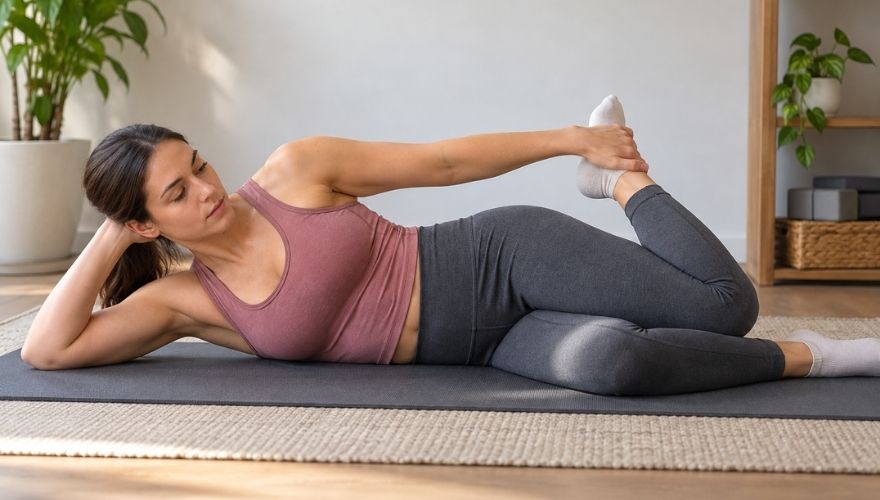
Some people experience more tightness through the front of their thighs than directly around the hip crease.
A side-lying stretch can address the rectus femoris, a muscle that performs both hip flexion and knee extension. How to perform it:
- Lie on your left side with your head supported and your lower knee bent for balance.
- Bend your right knee and gently hold your ankle.
- Keep your pelvis steady while moving your right thigh slightly backward.
- Gently bring your heel toward your glute until you feel tension along the front of your thigh.
- Hold for 20-30 seconds, then switch sides.
Use a stretching strap around your ankle if reaching your foot feels awkward. A 2022 clinical trial with knee osteoarthritis found that adding side-lying rectus femoris stretches to a four-week exercise program significantly improved knee flexion, pain, and walking performance compared with the same program without those stretches.
Common mistake: Pulling the ankle aggressively while rotating your pelvis backward. Because rectus femoris crosses two joints, bending the knee while extending the hip can increase tension along the muscle.
However, pulling harder isn’t necessarily helpful. If knee discomfort appears before you feel the intended stretch, reduce the knee bend or choose another exercise.
Why Do Your Hip Flexors Feel Tight After Sitting All Day?
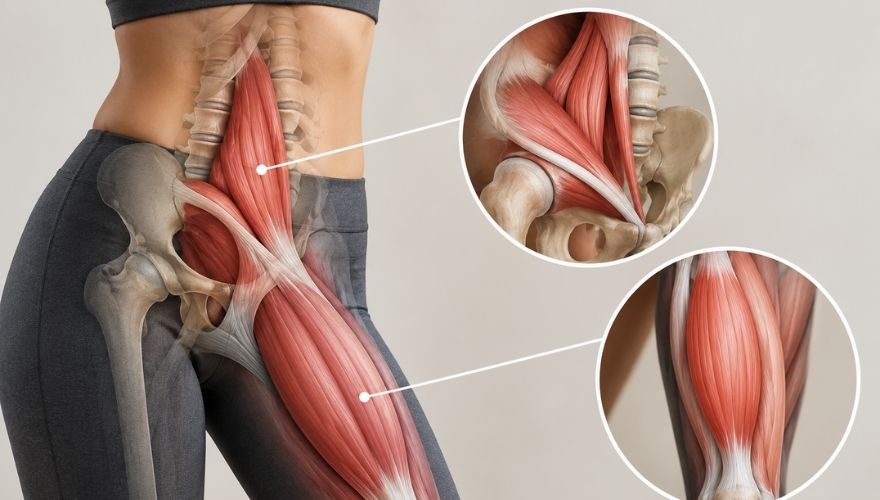
Hip flexors are a group of muscles responsible for bringing your thigh toward your torso. You use them when walking, climbing stairs, lifting your knee, and bending at the hip.
Two particularly important muscles are:
- Iliopsoas – Formed by the iliacus and psoas major, it helps flex the hip and contributes to stabilization around the pelvis.
- Rectus femoris – One of the quadriceps muscles, it crosses both the hip and knee, helping flex the hip and straighten the knee.
Sitting keeps your hips flexed, usually at an angle close to 90 degrees. Maintaining that position for hours limits opportunities for hip extension, which is one reason targeted hip flexor stretches can be useful after prolonged sitting.
Perceived tightness can also involve muscle fatigue, weakness, limited joint mobility, or increased sensitivity to certain positions.
Feeling stiff alone cannot establish which factor is responsible.
Hip stiffness sometimes accompanies lower-back discomfort because muscles around the pelvis influence how the hips and spine move together. Still, lower-back pain has several possible causes, and tight hip flexors aren’t automatically responsible.
How to Know If You’re Stretching Your Hip Flexors Correctly
Effective hip flexor stretches aren’t measured by how dramatic your position looks. What matters is controlling your pelvis and directing movement toward the intended muscles. Pay attention to four details:
1. Feel tension in the intended area.
Hip flexor stretching should produce a mild pulling sensation at the front of your hip or upper thigh. Sharp pain, catching, or pinching inside the hip joint isn’t a normal stretching target.
2. Control your pelvis.
A slight posterior pelvic tilt can help direct the movement toward hip extension. You don’t need to force your lower back completely flat or hold your pelvis rigidly.
3. Avoid borrowing movement through your spine.
If your lower back arches every time you move further into the stretch, you’re getting that extra movement through your spine, not necessarily your hip. Adjust your pelvis first, then see how much movement you actually have.
4. Breathe normally.
A study involving 23 healthy men found that a single hip flexor stretching session increased passive hip extension by an average of 2.6 degrees and reduced anterior pelvic tilt by 1.2 degrees.
Holding your breath or bracing your entire body can make it harder to maintain a comfortable position. Keep your shoulders relaxed and breathe steadily throughout the hold.
One useful detail often gets overlooked: your hip angle and knee angle influence which muscles receive the most tension.
For example, extending the hip with the knee relatively straight generally directs more attention toward the iliopsoas. Adding knee flexion can increase tension through the rectus femoris.
Neither position is automatically superior. Choose according to where you experience restriction and which movement you can perform comfortably.
How Often Should You Stretch Tight Hip Flexors?
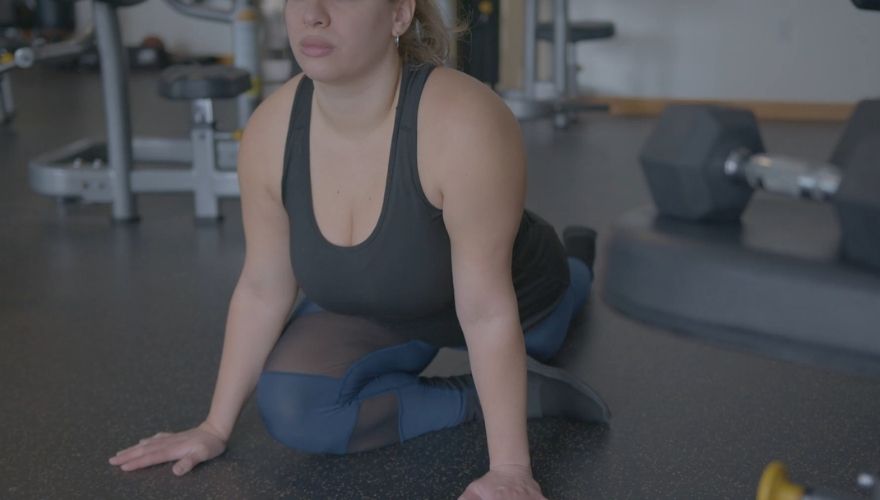
Consistency matters more than occasional intensive stretching sessions.
Timing also matters when stretching is part of a workout warm-up. Holding a static stretch for less than a minute generally has a smaller effect on immediate athletic performance than prolonged holds.
For desk workers taking a short mobility break, however, the main priority is maintaining a comfortable position rather than preparing for maximum physical effort.
Harvard Health Publishing advises holding comfortable static stretches for at least 15 seconds, repeating them two to four times, and stretching regularly.
Practicing hip flexor stretches daily may be appropriate when the movements feel comfortable, although several sessions per week can also help improve flexibility.
Gentle walking or moving your hips through a comfortable range before stretching may make the exercises easier.
A Simple Three-Minute Routine for Desk Workers
You don’t need to perform every variation during every break.
Consider the following routine:
| Exercise | Duration | Purpose |
|---|---|---|
| Gentle walking | 30 seconds | Introduce movement |
| Standing hip flexor stretch | 30 seconds per side | Stretch the front of each hip |
| Standing hip extensions | 10 controlled repetitions per side | Practice active hip movement |
| Gentle walking | 30 seconds | Return to normal movement |
Total time is approximately three minutes, depending on transition speed.
During standing hip extensions, move one leg slightly backward without arching your lower back. Keep the movement small and controlled.
Regular stretching can improve range of motion over time, but temporary relief after a session doesn’t necessarily indicate a lasting change in muscle length.
Hip flexor stretch benefits are most useful when considered alongside regular movement and strengthening rather than as a permanent solution to prolonged sitting.
Why Stretching Alone May Not Be Enough
Stretching addresses one part of hip mobility, but comfortable movement also depends on muscular strength, joint function, and how frequently you change positions.
Strengthen the Muscles Supporting Your Hips
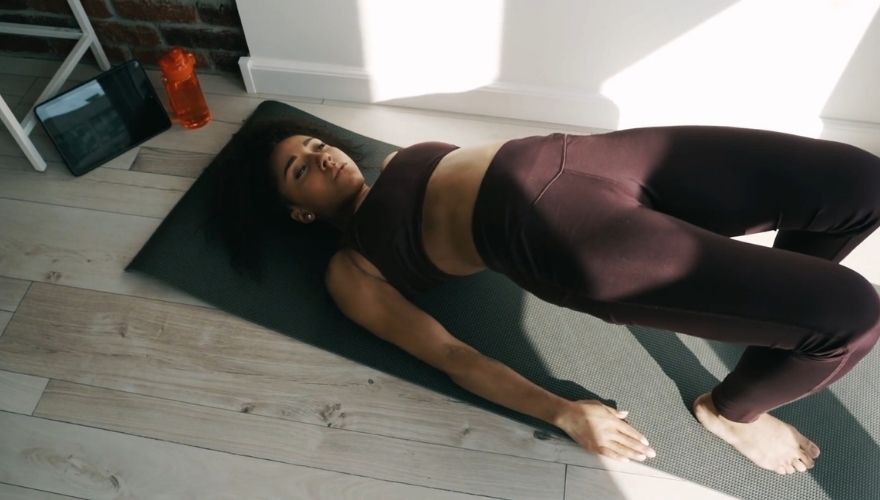
Glutes help extend and stabilize the hips. Core muscles contribute to control around the pelvis and trunk.
Weakness in these areas may affect movement patterns and contribute to the sensation of stiffness.
Hospital for Special Surgery also recommends exercises such as glute bridges and planks alongside stretching to support hip function.
A basic glute bridge is a useful starting point:
- Lie on your back with your knees bent and feet flat.
- Gently tighten your abdominal muscles.
- Press through your feet and lift your hips.
- Pause briefly without arching your lower back.
- Lower slowly and repeat for 8-12 controlled repetitions.
Start with one set and increase gradually as tolerated.
A 2023 analysis of 55 studies found that resistance training increased joint range of motion, with no statistically significant difference compared with stretching programs.
Interrupt Long Periods of Sitting
You can perform excellent hip flexor stretches every evening and still spend most of the day barely moving your hips.
Changing positions regularly addresses that problem more directly.
Hospital for Special Surgery recommends changing position approximately every 30-45 minutes to help avoid prolonged stiffness.
For a practical routine, aim to stand, walk, or move around every 30-60 minutes, adjusting that schedule to your comfort and workload.
A short walk to refill your water, several controlled hip extensions, or a brief standing break can interrupt continuous sitting.
No particular position needs to be maintained all day perfectly. Frequent changes are generally more useful than trying to hold one supposedly ideal posture for hours.
Summary
Effective hip flexor stretching doesn’t require complicated exercises or extreme flexibility.
Half-kneeling and standing variations are practical starting points for desk workers. Supine stretching offers additional support, while side-lying exercises can help address front-of-thigh tightness.
A 13-year study examining flexibility and longevity found an association between flexibility scores and survival. Although that doesn’t establish that stretching increases lifespan, it provides another reason to treat mobility as one part of maintaining physical function throughout adulthood.
Choose one or two variations that feel comfortable, pay attention to pelvic positioning, and practice consistently.
A few well-performed stretches can be useful, but they won’t replace moving throughout the day. Pay attention to where the movement comes through, keep your technique controlled, and give your hips regular opportunities to do more than sit.